“First, What kind of life was lived in this place, that is, Why and how did its builders build as they did?
And second, what rules with general validity and applicability did they follow?”
Carroll William Westfall, Learning From Pompeii.


Showing posts with label Thomas Crawford. Show all posts

Thursday, July 16, 2015

Civic Markers II: Monuments as Ordering Elements in the City

"The status of monuments on the cusp of the twenty-first century is double-edged and fraught with an essential tension: outside of those nations with totalitarian pasts, the public and governmental hunger for traditional, self-aggrandizing monuments is matched only by the contemporary artists’ skepticism of the monument" 
James E. Young, “Memory/Monument,” 2010
Lord Botetourt
Civic Markers II: Monuments as Ordering Elements in the City

Political leaders across the nation followed classical precedent in the employment of  rhetorical narratives, sponsoring civic art works to expound on important civic concepts, most often associated with a former military or political leader. Virginia, indeed, began a tradition of public statuary with the marble figure of a much loved royal governor. One of the earliest examples of public statuary in the colonies, the statue of Lord Botetourt, was placed in the central arcade of the Williamsburg Capitol in 1773. 

At first, Richmond, in its role as the new capitol of the commonwealth, built its narrative around political and military figures who were not necessarily local heroes. The state’s leaders memorialized the founding fathers and the larger-than life role Virginians played in the founding of the nation. In 1796, Houdon’s virtuoso life-size sculpture of George Washington took a central place in the new Capitol, a position that was equivalent to that previously occupied by Lord Botetourt’s statue in Williamsburg. Both Botetourt and Washington were here treated as modern citizens in modern dress, although Washington was accompanied by the symbols of the Roman hero Cincinnatus, who, like Washington, turned from war-craft to farming. 


As Charles Brownell and his student Ramin Saadat asked, why, at the Virginia Capitol, had Jefferson "devised a templelike exterior and a templelike core surrounding a white marble statue in a fashion suggesting divine honors?” The answer, they suggest, may lie in the popular theory, known as Euhemerism, that saw the origin of ancient gods in mortal “leaders or benefactors” whose veneration had “naively evolved into worship.” 

It became necessary to call upon at least a modicum of myth in order to craft  an aestheticized history that met the new nation’s ideological needs. . . .  “American” versions of the methods by which Italy’s Renaissance packed the past with rich meanings eventually found their way into the national imagination, especially after the rising commitment to manifest destiny began to overlay republican modesty with grandiose images of heroic glory. But in the beginning the Capitol dealt with America’s first president in its own way. By a reversal of the euhemeristic tradition, as we will see in the making of the myth of George Washington, the mortal man became a demigod. 

George Washington as America’s savior general and first president would endow the nation’s capital with what Renaissance Italy named civile- “the affective identification of the [citizen] with a particular, geographically defined place,” as well as “a belief in the sacred nature of institutions and leaders, an attitude that invests things and persons political with a mystical aura, distinguishing them from mundane structures and from ordinary mortals.”

Public ceremonies required the right person to represent the nature of the republican virtues Americans were making up as they went along. . . . In both the Old World and the new, ceremonies of adventus sealed the relation of leaders to the people (private individuals, the military, the administrative staffs). They confirmed the needed sense of stability and order, backed by a coherent bureaucratic system. Over time, however, it became unnecessary to highlight the “action” by which a leader “arrives.” He is “just there” through a process that has been “completed and consummated.” . . . John Quincy Adams was deeply depressed by the implications of the inability to reach a compromise over the final resting place of the nation’s foremost symbol of unity. In his diary of February 22, 1832, Adams wrote that the wish for the capitol to be the site of Washington’s tomb had been “connected with an imagination that this federal Union was to last for ages. I now disbelieve its duration for twenty years, and doubt its continuance for five. It is falling into the sear and yellow leaf” [Martha Banta, One True Theory and the Quest for an American Aesthetic (Yale U Press, 2007, 77ff].

The indoor statue of Washington, “its form the result of a transatlantic dialog between Houdon, Thomas Jefferson, then serving as minister plenipotentiary to the court of Louis XVI, political figures in Virginia, and Washington himself,” depicted him as a modern Cincinnatus, the Roman general who voluntarily returned to farming after his success at war.  Maurie D. McInnis sees this as entirely appropriate republican imagery for the post-revolutionary period. Changes in the nation’s self-understanding gave impetus to an entirely different project for memorializing Washington in the 1850s, one that “captures the changing meaning of Washington and the Revolution for different generations of Virginians.  “By the middle of the nineteenth century, however, Washington as Marcus Aurelius, the great military leader, seemed more appropriate to Virginia’s leading men. . . . The second, by Crawford, was a response to the first, commissioned by a later generation of Virginians, who, in the 1850s, were attracted not to the symbols of pastoral virtue, but instead to the military might of Washington, as sectional tensions dictated a celebration of Washington’s military prowess as a defender of Southern liberties [Maurie McInnis, “George Washington, Cincinnatus or Marcus Aurelius?” from Peter S. Onuf and Nicholas P. Cole eds, Thomas Jefferson, the Classical World, and Early America. University of Virginia P, 2011].   

Thomas Crawford's equestrian Washington, 1858
Thus the Richmond tradition of outdoor public military monuments began with a sculptural composition to immortalizing in bronze and granite Virginia’s role in the nation’s founding and Virginia’s most famous citizen, George Washington. Maximilian Godefroy, who prepared landscape plans for Capitol Square, had proposed a triumphal arch in front of the capitol’s portico as well as a viewing platform/water tower to its west. The General Assembly authorized a public subscription for a monument and burial place on the Capitol Square for Washington in 1817. After years of inaction, a committee of citizens proposed a competition for the monument, which was held in 1849. The selected sculptor was Thomas Crawford, an American working in Rome. The popular and successful monument was not only a tribute to Washington as military and political leader, but an elaborate allegory linking Virginia with the national polity.


The monumental composition stands on a granite base appropriately shaped like a hexagonal star fortress. The design includes two tiers of supporting sculptures around a massive bronze equestrian figure of Washington, cast in Germany. The upper row of pedestals support statues of six Virginia patriots- Thomas Jefferson, George Mason, John Marshall, Andrew Lewis, Thomas Nelson, and Patrick Henry. The lowest tier consisted of six allegorical female figures and trophies representing revolutionary virtues (and places) allied with the six patriots. Andrew Lewis is allied with “colonial times,” Patrick Henry with revolution, George Mason with the Bill of Rights, Thomas Jefferson with independence, Thomas Nelson with finance, and John Marshall with justice. Crawford died having completed only the sculptures of Washington, Jefferson, and Henry.  His student, Randolph Rogers, completed the remaining pedestal sculptures after the Civil War.  The monument strongly reinforces the urban order by serving as a objective at the end of Grace Street at the entrance to Capitol Square. It stands on axis with the Governor’s Mansion and in an effective non-axial introductory relationship with the Capitol itself. The nearby Washington Tavern was renamed the Monumental Tavern in its honor [Hopson Goddin, Richmond Virginia 1861- 1865, Civil War Centennial Committee, 1961].


Henry Clay Statue under the octagonal canopy, 1860

The Washington monument did not stand alone in Capitol Square for long. It was followed by the life-sized Henry Clay statue in 1860, located north of the Capitol. Henry Clay, born in Hanover County, Virginia, was a renowned statesman, orator, and long-serving speaker of the the U.S. House of Representatives who had studied law in Richmond with George Wythe. Clay was a hero to the Whig population of the city, who favored federalist policies promoting economic, social, and moral modernization in opposition to the populism of Andrew Jackson. The artist was the Kentucky-born sculptor Joel T. Hart (1810-1875). The statue was commissioned in 1845 by the Ladies Clay Association, in order to rescue his cause “from the foulest slanders ever invented for party purposes” during the presidential election of 1844 and to “teach our Sons to honor [his] name- and imitate [his] noble deeds” [The Papers of Henry Clay, January 1, 1844-June 29,1852, 1991: U P of Kentucky:203]. 

It took Hart until 1859 to arrange production of the marble sculpture in Italy.  The statue was placed under an octagonal, domed covering soon after its dedication in 1860. The cast-iron canopy, supported on eight Corinthian columns, was itself a major public amenity in Capitol Square and emphasized the heroic status of Clay in the eyes of the city. Unfortunately, the fifteen-year delay in the production of the monument meant that its intended influence in favor or compromise and federalism was of no use at the start of the Civil War. Unlike George Washington, the significance of Henry Clay was largely forgotten by the early twentieth century. The domed temple was demolished in the 1930s and the statue placed inside the Capitol.  


A life-sized statue of Thomas J. “Stonewall” Jackson was placed nearby in 1875, beginning a line of monuments that would be erected in the twentieth century along the northern edge of the square. The bronze sculpture was made in 1875 by Irish sculptor John Henry Foley and was the gift of “English gentlemen as a tribute of admiration.” 

It was a result of its former role of “national capitol” that Richmond acquired an extensive and more urbane collection of public art surpassing that of other state capitals of comparable size. The armature of monuments extending from the old city into the projected suburbs to the west was the serendipitous result, not of public planning, but of a family who wished to extend the city through their property.

Monument Avenue

Richmond's great urban processional route, Monument Avenue, represents the transformation of loss and suffering into a symbolic reconstruction of the partially burned city as a monument to its aspirations. As Lucien Steil has said: "The city is indeed the highest form of commemoration, the highest expression of resilience, the most beautiful synthesis of human culture." Lucien Steil, "Reconstruction and Commemoration." American Arts Quarterly, 4:3 (Winter 2015). 

Monument Avenue was laid out in 1887, not only to serve as an appropriate setting for the heroic statue of Robert E. Lee planned to stand at the center of a great circle at its eastern end, but as a grand extension of the city to the west.

As was documented by Jay Killian Bowman Williams, Monument Avenue was largely the creation of its property owners, beginning with the Allen family, who owned the site of Lee Circle. The city and most of the promoters of the statue wanted it to be placed in a familiar and existing location such as Capitol Square, Libby Hill, or Monroe Park. The Board of the Lee Memorial Association, having been convinced by, among others, Augustus St. Gaudens, that an accomplished European sculptor would produce the best work, hired Frenchman Jean Antoine Mercier and mandated a calm, serene Lee who would project a sense of the moral and aesthetic seriousness of the southern cause missing in the booming New South city that doubled in size between 1860 and 1890 [Jay Killian Bowman Williams, Changed Views and Unforeseen Prosperity: Richmond of 1890 Gets a 
Monument to Lee (Richmond: privately printed, 1969)]. 

Col. Otway Allen promoted his vision for his tract of undeveloped land at the western end of Franklin Street as the best place for the monument. Franklin Street was the pre-eminent residential axis, extending from Capitol Square’s Bell Tower to the city’s western limits. Allen insisted that “no better situation (as far as a site for the Lee Monument) could be obtained than at the head of Franklin Street. There is a prospect of the street being opened, and a place similar to Monument Place in Baltimore being laid out. Should this be done, where is a situation to compare with it?” 

A famous image of the Lee Monument, with a crop of tobacco growing in front of it. This has always looked to us like a  a publicity stunt.
Writers, including Henry James, who have mocked the messy selection process and the lonely situation of the Lee Monument in an undeveloped landscape, have failed to grasp the developers’ foresight and the similarity of this project other grand urban expansions.  Early Monument Avenue compares favorably with the dreary expanses of nineteenth-century District of Columbia. In previous decades, Baltimore’s Washington Monument (1815-1829) preceded development of its projected setting in Mount Vernon Square by many years. 

By the late nineteenth century, Richmond’s civic leaders lacked the political capacity to imagine or provide such a generously scaled setting for the monument on their own. This kind of effort required an unprecedented manipulation of the city’s grid, as ambitious, in its own way, as the creation of the great boulevards that were driven through the heart of Paris by Hausmann. Collison Pierpont Edwards Burgwyn, a civil engineer, novelist, and playwright employed by the Allens, laid out the 200-foot diameter Lee Circle and the two 140-foot wide boulevards converging on it. Monument Avenue closely resembles Frederick Law Olmstead’s contemporary project at Commonwealth Avenue in Boston. In a similar way, Commonweath Avenue was laid out on private land as the idea of developer and street railway operator, Henry M. Whitney.  

Monument Avenue looking west from Stuart Circle
Monument Avenue gradually extended to the west and its intersections became the settings for a sequence of public sculpture on a scale rarely achieved in an American city. Monumentally scaled statues of Confederate figures, some more effective than others, and none as fine as Lee’s, were eventually placed at the center of every other intersection for more than a mile. 

Older parts of the city had made no distinction among streets or sections by building type or land use, and streets were able to incorporate changes in form and use over time. This new boulevard was intended serve a distinctly residential suburban sector and was not intended to be a principal thoroughfare. Eventually, however, with the coming of the automobile it became a convenient commuters’ route into the city.  Oddly, and due to its emphatically axial form, Monument Avenue doesn’t accommodate public buildings quite as well as the older, reticulated parts of the city. Except at Stuart Circle, where two churches, a hospital, and an apartment building manage to enclose the more intimate circle there, churches and the few other larger buildings fail to fully engage with the street’s massive scale. One success in this regard is the temple-form church at the south end of Allen Street, which effectively terminates that street.     

Other Post-Civil War Civic Markers

While the Allens were developing Monument Avenue, another individual was responsible for creatively managing urban-scale improvements across a post-war city with little interest in spending money on public works. Col. Wilfred Emory Cutshaw, a VMI-trained engineer, began a long career as city engineer in 1873.  According to Tyler Potterfield, Cutshaw, who was responsible for the planning and supervision of municipal projects, “fully recognized the importance of neighborhood squares, tirelessly advocated for their improvement and oversaw a team of assistant city engineers who proved to be talented landscape designers.” Preparation for his position included travel to study up-to-date parks in the North and in Europe in 1879. 

Soldiers and Sailors Monument by William Ludwell Sheppard, 1894
 Cutshaw landscaped Monroe Park and the large “promontory parks” overlooking the James. He also acquired the small triangular parks that enliven Park Avenue in the Fan District and organized a sophisticated tree-planting program that provided shade throughout the city’s streets and parks in accord with the City Beautiful movement, an urban design branch of the American Renaissance.  His plan to create a dramatic monument to Robert E. Lee on the top of Libby Hill Park was rejected, but in its place he projected the Soldiers and Sailors Monument of 1894, which took the form of a Roman monumental column, placed on a highly visible axis carefully aligned with Main Street to the west [T. Tyler Potterfield, Nonesuch Place: A History of the Richmond Landscape (History Press, 2009)].


A triumphal arch constructed as a temporary 
entry gateway to the popular Street
Carnival held on Broad Street
in 1900. 
Arches have long been a theme in monumental Richmond. Street-spanning arches were proposed, but not built, for both George Washington and Jefferson Davis. Their lack of success is particularly instructive in the inherent contentiousness of myth- and monument-making in a democratic regime. A temporary triumphal arch "beautifully festooned with flowers and evergreens," was built over Main Street at 19th Street beside the Union Hotel for Lafayette's parade in 1824. Thirteen girls "stood upon the arch to represent the thirteen original states" [Dan Murphy's Reminiscences, Part II]. The success of temporary arches built over Broad Street in 1900 and 1901 for street carnivals that were designed to “boost” the city seems to have prompted the United Daughters of the Confederacy to propose a monumental arch in 1902 over Broad Street at the intersection of Twelfth Street as a memorial to Jefferson Davis (the dramatic location where Broad Street drops off into the Shockoe Valley attracted propsals for structures at the urban scale over the years, starting with the Shockoe Market and Latrobe’s unexecuted project for a new Episcopal church, both proposed for the center of the street).


"Triumphal" arch in stone proposed for Monroe Park soon after Jefferson Davis' death in 1889.
An arch was again suggested to span Broad Street in 1901 [City on the James, 1893].

The grandious project broke down due to the sensible objections of Davis' widow, who indicated that she was opposed the location and the form of the proposed monument, not to mention its being harnessed to the promotion of the city. She declared that "arches, as monuments, have been built to perpetuate deeds of men and to express the idea of a ‘victory achieved.’ A triumphal arch to the memory of a man whose cause failed. . . is surely an inappropriate way to express respect for his memory, and certainly might excite ridicule in many quarters. Bound by a thousand most tender ties and a warm sympathy to Richmond, yet even to beautify the city I cannot approve the site at Broad and Twelfth Streets. . . . [at] the intersection of two of the noisiest and busiest streets, lined with shops and frequented by crowds of people of a prosperous and growing city" [Richmond Dispatch 1 June 1902]. 

First Regiment of Virginia Monument at Park Stuart and Meadow streets by Ferruccio Legnaioli
Additional Statues

A tradition began of placing statues at key points around the city, begun by Cutshaw, continued to punctuate the axes of transportation routes and along paths in public parks. These include the statue of A.P. Hill at Laburnum and Hermitage and the figure of Williams Carter Wickham (1820 –1888), a lawyer, judge, politician, and Confederate Cavalry commander, who image was placed in Monroe Park by his war-time comrades and employees at the Chesapeake and Ohio Railway in 1891. It was sculpted by Richmond’s Edward V. Valentine. The Richmond Howizers Monument (1892) and the Monument to the First Regiment of Virginia Infantry (1930) punctuate the irregular route of Park Avenue as it wends its way through the Fan District. 


Columbus statue and fountain

As the Fan District was extended to the west, Boulevard was laid out in 1875 as a grand cross street to connect Reservoir (Byrd) Park to Broad Street. The terminus at the foot of the great reservoir was given an suitably architectural effect by the placement of a small cascade fountain symbolizing the civic provision of water fronted by a statue of Columbus. This was placed in front of the fountain in 1925 by a group of citizens of Italian origin and sculpted by immigrant sculptor Ferruccio Legnaioli.


The discourse on Richmond's Civic Markers will continue with Part III- Fountains.

For a discussion of contemporary monumental art, see Public Art and Community Memory: Richmond's Maggie Lena Walker.
Friday, August 29, 2014

Civic Markers II: Monuments as Ordering Elements in the City

"The status of monuments on the cusp of the twenty-first century is double-edged and fraught with an essential tension: outside of those nations with totalitarian pasts, the public and governmental hunger for traditional, self-aggrandizing monuments is matched only by the contemporary artists’ skepticism of the monument" 
James E. Young, “Memory/Monument,” 2010
Lord Botetourt
  II. Monuments as Ordering Elements in the City

Political leaders across the nation followed classical precedent in the employment of  rhetorical narratives, sponsoring civic art works to expound on important civic concepts, most often associated with a former military or political leader. Virginia, indeed, began a tradition of public statuary with the marble figure of a much loved royal governor. One of the earliest examples of public statuary in the colonies, the statue of Lord Botetourt, was placed in the central arcade of the Williamsburg Capitol in 1773. 

At first, Richmond, in its role as the new capitol of the commonwealth, built its narrative around political and military figures who were not necessarily local heroes. The state’s leaders memorialized the founding fathers and the larger-than life role Virginians played in the founding of the nation. In 1796, Houdon’s virtuoso life-size sculpture of George Washington took a central place in the new Capitol, a position that was equivalent to that previously occupied by Lord Botetourt’s statue in Williamsburg. Both Botetourt and Washington were here treated as modern citizens in modern dress, although Washington was accompanied by the symbols of the Roman hero Cincinnatus, who, like Washington, turned from war-craft to farming. 


As Charles Brownell and his student Ramin Saadat asked, at the Virginia Capitol, why had Jefferson "devised a templelike exterior and a templelike core surrounding a white marble statue in a fashion suggesting divine honors.” The answer, they suggest, may lie in the popular theory, known as Euhemerism, that saw the origin of ancient gods in mortal “leaders or benefactors” whose veneration had “naively evolved into worship.” 

It became necessary to call upon at least a modicum of myth in order to craft  an aestheticized history that met the new nation’s ideological needs. . . .  “American” versions of the methods by which Italy’s Renaissance packed the past with rich meanings eventually found their way into the national imagination, especially after the rising commitment to manifest destiny began to overlay republican modesty with grandiose images of heroic glory. But in the beginning the Capitol dealt with America’s first president in its own way. By a reversal of the euhemeristic tradition, as we will see in the making of the myth of George Washington, the mortal man became a demigod. 

George Washington as America’s savior general and first president would endow the nation’s capital with what Renaissance Italy named civile- “the affective identification of the [citizen] with a particular, geographically defined place,” as well as “a belief in the sacred nature of institutions and leaders, an attitude that invests things and persons political with a mystical aura, distinguishing them from mundane structures and from ordinary mortals.”

Public ceremonies required the right person to represent the nature of the republican virtues Americans were making up as they went along. . . . In both the Old World and the new, ceremonies of adventus sealed the relation of leaders to the people (private individuals, the military, the administrative staffs). They confirmed the needed sense of stability and order, backed by a coherent bureaucratic system. Over time, however, it became unnecessary to highlight the “action” by which a leader “arrives.” He is “just there” through a process that has been “completed and consummated.” . . . John Quincy Adams was deeply depressed by the implications of the inability to reach a compromise over the final resting place of the nation’s foremost symbol of unity. In his diary of February 22, 1832, Adams wrote that the wish for the capitol to be the site of Washington’s tomb had been “connected with an imagination that this federal Union was to last for ages. I now disbelieve its duration for twenty years, and doubt its continuance for five. It is falling into the sear and yellow leaf” [Martha Banta, One True Theory and the Quest for an American Aesthetic (Yale U Press, 2007, 77ff].

The indoor statue of Washington, “its form the result of a transatlantic dialog between Houdon, Thomas Jefferson, then serving as minister plenipotentiary to the court of Louis XVI, political figures in Virginia, and Washington himself,” depicted him as a modern Cincinnatus, the Roman general who voluntarily returned to farming after his success at war.  Maurie D. McInnis sees this as entirely appropriate republican imagery for the post-revolutionary period. Changes in the nation’s self-understanding gave impetus to an entirely different project for memorializing Washington in the 1850s, one that “captures the changing meaning of Washington and the Revolution for different generations of Virginians.  “By the middle of the nineteenth century, however, Washington as Marcus Aurelius, the great military leader, seemed more appropriate to Virginia’s leading men. . . . The second, by Crawford, was a response to the first, commissioned by a later generation of Virginians, who, in the 1850s, were attracted not to the symbols of pastoral virtue, but instead to the military might of Washington, as sectional tensions dictated a celebration of Washington’s military prowess as a defender of Southern liberties [Maurie McInnis, “George Washington, Cincinnatus or Marcus Aurelius?” from Peter S. Onuf and Nicholas P. Cole eds, Thomas Jefferson, the Classical World, and Early America. University of Virginia P, 2011].   

Thomas Crawford's equestrian Washington, 1858
Thus the Richmond tradition of outdoor public military monuments began with a sculptural composition to immortalizing in bronze and granite Virginia’s role in the nation’s founding and Virginia’s most famous citizen, George Washington. Maximilian Godefroy, who prepared landscape plans for Capitol Square, had proposed a triumphal arch in front of the capitol’s portico as well as a viewing platform/water tower to its west. The General Assembly authorized a public subscription for a monument and burial place on the Capitol Square for Washington in 1817. After years of inaction, a committee of citizens proposed a competition for the monument, which was held in 1849. The selected sculptor was Thomas Crawford, an American working in Rome. The popular and successful monument was not only a tribute to Washington as military and political leader, but an elaborate allegory linking Virginia with the national polity.


The monumental composition stands on a granite base appropriately shaped like a hexagonal star fortress. The design includes two tiers of supporting sculptures around a massive bronze equestrian figure of Washington, cast in Germany. The upper row of pedestals support statues of six Virginia patriots- Thomas Jefferson, George Mason, John Marshall, Andrew Lewis, Thomas Nelson, and Patrick Henry. The lowest tier consisted of six allegorical female figures and trophies representing revolutionary virtues (and places) allied with the six patriots. Andrew Lewis is allied with “colonial times,” Patrick Henry with revolution, George Mason with the Bill of Rights, Thomas Jefferson with independence, Thomas Nelson with finance, and John Marshall with justice. Crawford died having completed only the sculptures of Washington, Jefferson, and Henry.  His student, Randolph Rogers, completed the remaining pedestal sculptures after the Civil War.  The monument strongly reinforces the urban order by serving as a objective at the end of Grace Street at the entrance to Capitol Square. It stands on axis with the Governor’s Mansion and in an effective non-axial introductory relationship with the Capitol itself. The nearby Washington Tavern was renamed the Monumental Tavern in its honor [Hopson Goddin, Richmond Virginia 1861- 1865, Civil War Centennial Committee, 1961].


Henry Clay Statue under the octagonal canopy, 1860

The Washington monument did not stand alone in Capitol Square for long. It was followed by the life-sized Henry Clay statue in 1860, located north of the Capitol. Henry Clay, born in Hanover County, Virginia, was a renowned statesman, orator, and long-serving speaker of the the U.S. House of Representatives who had studied law in Richmond with George Wythe. Clay was a hero to the Whig population of the city, who favored federalist policies promoting economic, social, and moral modernization in opposition to the populism of Andrew Jackson. The artist was the Kentucky-born sculptor Joel T. Hart (1810-1875). The statue was commissioned in 1845 by the Ladies Clay Association, in order to rescue his cause “from the foulest slanders ever invented for party purposes” during the presidential election of 1844 and to “teach our Sons to honor [his] name- and imitate [his] noble deeds” [The Papers of Henry Clay, January 1, 1844-June 29,1852, 1991: U P of Kentucky:203]. 

It took Hart until 1859 to arrange production of the marble sculpture in Italy.  The statue was placed under an octagonal, domed covering soon after its dedication in 1860. The cast-iron canopy, supported on eight Corinthian columns, was itself a major public amenity in Capitol Square and emphasized the heroic status of Clay in the eyes of the city. Unfortunately, the fifteen-year delay in the production of the monument meant that its intended influence in favor or compromise and federalism was of no use at the start of the Civil War. Unlike George Washington, the significance of Henry Clay was largely forgotten by the early twentieth century. The domed temple was demolished in the 1930s and the statue placed inside the Capitol.  


A life-sized statue of Thomas J. “Stonewall” Jackson was placed nearby in 1875, beginning a line of monuments that would be erected in the twentieth century along the northern edge of the square. The bronze sculpture was made in 1875 by Irish sculptor John Henry Foley and was the gift of “English gentlemen as a tribute of admiration.” 

It was a result of its former role of “national capitol” that Richmond acquired an extensive and more urbane collection of public art surpassing that of other state capitals of comparable size. The armature of monuments extending from the old city into the projected suburbs to the west was the serendipitous result, not of public planning, but of a family who wished to extend the city through their property.

Monument Avenue

Richmond's great urban processional route, Monument Avenue, represents the transformation of loss and suffering into a symbolic reconstruction of the partially burned city as a monument to its aspirations. As Lucien Steil has said: "The city is indeed the highest form of commemoration, the highest expression of resilience, the most beautiful synthesis of human culture." Lucien Steil, "Reconstruction and Commemoration." American Arts Quarterly, 4:3 (Winter 2015). 

Monument Avenue was laid out in 1887, not only to serve as an appropriate setting for the heroic statue of Robert E. Lee planned to stand at the center of a great circle at its eastern end, but as a grand extension of the city to the west.

As was documented by Jay Killian Bowman Williams, Monument Avenue was largely the creation of its property owners, beginning with the Allen family, who owned the site of Lee Circle. The city and most of the promoters of the statue wanted it to be placed in a familiar and existing location such as Capitol Square, Libby Hill, or Monroe Park. The Board of the Lee Memorial Association, having been convinced by, among others, Augustus St. Gaudens, that an accomplished European sculptor would produce the best work, hired Frenchman Jean Antoine Mercier and mandated a calm, serene Lee who would project a sense of the moral and aesthetic seriousness of the southern cause missing in the booming New South city that doubled in size between 1860 and 1890 [Jay Killian Bowman Williams, Changed Views and Unforeseen Prosperity: Richmond of 1890 Gets a 
Monument to Lee (Richmond: privately printed, 1969)]. 

Col. Otway Allen promoted his vision for his tract of undeveloped land at the western end of Franklin Street as the best place for the monument. Franklin Street was the pre-eminent residential axis, extending from Capitol Square’s Bell Tower to the city’s western limits. Allen insisted that “no better situation (as far as a site for the Lee Monument) could be obtained than at the head of Franklin Street. There is a prospect of the street being opened, and a place similar to Monument Place in Baltimore being laid out. Should this be done, where is a situation to compare with it?” 

A famous image of the Lee Monument, with a crop of tobacco growing in front of it. This has always looked to us like a  a publicity stunt.
Writers, including Henry James, who have mocked the messy selection process and the lonely situation of the Lee Monument in an undeveloped landscape, have failed to grasp the developers’ foresight and the similarity of this project other grand urban expansions.  Early Monument Avenue compares favorably with the dreary expanses of nineteenth-century District of Columbia. In previous decades, Baltimore’s Washington Monument (1815-1829) preceded development of its projected setting in Mount Vernon Square by many years. 

By the late nineteenth century, Richmond’s civic leaders lacked the political capacity to imagine or provide such a generously scaled setting for the monument on their own. This kind of effort required an unprecedented manipulation of the city’s grid, as ambitious, in its own way, as the creation of the great boulevards that were driven through the heart of Paris by Hausmann. Collison Pierpont Edwards Burgwyn, a civil engineer, novelist, and playwright employed by the Allens, laid out the 200-foot diameter Lee Circle and the two 140-foot wide boulevards converging on it. Monument Avenue closely resembles Frederick Law Olmstead’s contemporary project at Commonwealth Avenue in Boston. In a similar way, Commonweath Avenue was laid out on private land as the idea of developer and street railway operator, Henry M. Whitney.  

Monument Avenue looking west from Stuart Circle
Monument Avenue gradually extended to the west and its intersections became the settings for a sequence of public sculpture on a scale rarely achieved in an American city. Monumentally scaled statues of Confederate figures, some more effective than others, and none as fine as Lee’s, were eventually placed at the center of every other intersection for more than a mile. 

Older parts of the city had made no distinction among streets or sections by building type or land use, and streets were able to incorporate changes in form and use over time. This new boulevard was intended serve a distinctly residential suburban sector and was not intended to be a principal thoroughfare. Eventually, however, with the coming of the automobile it became a convenient commuters’ route into the city.  Oddly, and due to its emphatically axial form, Monument Avenue doesn’t accommodate public buildings quite as well as the older, reticulated parts of the city. Except at Stuart Circle, where two churches, a hospital, and an apartment building manage to enclose the more intimate circle there, churches and the few other larger buildings fail to fully engage with the street’s massive scale. One success in this regard is the temple-form church at the south end of Allen Street, which effectively terminates that street.     

Other Post-Civil War Civic Markers

While the Allens were developing Monument Avenue, another individual was responsible for creatively managing urban-scale improvements across a post-war city with little interest in spending money on public works. Col. Wilfred Emory Cutshaw, a VMI-trained engineer, began a long career as city engineer in 1873.  According to Tyler Potterfield, Cutshaw, who was responsible for the planning and supervision of municipal projects, “fully recognized the importance of neighborhood squares, tirelessly advocated for their improvement and oversaw a team of assistant city engineers who proved to be talented landscape designers.” Preparation for his position included travel to study up-to-date parks in the North and in Europe in 1879. 

Soldiers and Sailors Monument by William Ludwell Sheppard, 1894
 Cutshaw landscaped Monroe Park and the large “promontory parks” overlooking the James. He also acquired the small triangular parks that enliven Park Avenue in the Fan District and organized a sophisticated tree-planting program that provided shade throughout the city’s streets and parks in accord with the City Beautiful movement, an urban design branch of the American Renaissance.  His plan to create a dramatic monument to Robert E. Lee on the top of Libby Hill Park was rejected, but in its place he projected the Soldiers and Sailors Monument of 1894, which took the form of a Roman monumental column, placed on a highly visible axis carefully aligned with Main Street to the west [T. Tyler Potterfield, Nonesuch Place: A History of the Richmond Landscape (History Press, 2009)].


A triumphal arch constructed as a temporary 
entry gateway to the popular Street
Carnival held on Broad Street
in 1900. 
Arches have long been a theme in monumental Richmond. Street-spanning arches were proposed, but not built, for both George Washington and Jefferson Davis. Their lack of success is particularly instructive in the inherent contentiousness of myth- and monument-making in a democratic regime. The success of temporary arches built over Broad Street in 1900 and 1901 for street carnivals that were designed to “boost” the city seems to have prompted the United Daughters of the Confederacy to propose a monumental arch in 1902 over Broad Street at the intersection of Twelfth Street as a memorial to Jefferson Davis (the dramatic location where Broad Street drops off into the Shockoe Valley attracted propsals for structures at the urban scale over the years, starting with the Shockoe Market and Latrobe’s unexecuted project for a new Episcopal church, both proposed for the center of the street).


"Triumphal" arch in stone proposed for Monroe Park soon after Jefferson Davis' death in 1889.
An arch was again suggested to span Broad Street in 1901 [City on the James, 1893].

The grandious project broke down due to the sensible objections of Davis' widow, who indicated that she was opposed the location and the form of the proposed monument, not to mention its being harnessed to the promotion of the city. She declared that "arches, as monuments, have been built to perpetuate deeds of men and to express the idea of a ‘victory achieved.’ A triumphal arch to the memory of a man whose cause failed. . . is surely an inappropriate way to express respect for his memory, and certainly might excite ridicule in many quarters. Bound by a thousand most tender ties and a warm sympathy to Richmond, yet even to beautify the city I cannot approve the site at Broad and Twelfth Streets. . . . [at] the intersection of two of the noisiest and busiest streets, lined with shops and frequented by crowds of people of a prosperous and growing city" [Richmond Dispatch 1 June 1902]. 
First Regiment of Virginia Monument at Park Stuart and Meadow streets by Ferruccio Legnaioli
Additional Statues

A tradition began of placing statues at key points around the city, begun by Cutshaw, continued to punctuate the axes of transportation routes and along paths in public parks. These include the statue of A.P. Hill at Laburnum and Hermitage and the figure of Williams Carter Wickham (1820 –1888), a lawyer, judge, politician, and Confederate Cavalry commander, who image was placed in Monroe Park by his war-time comrades and employees at the Chesapeake and Ohio Railway in 1891. It was sculpted by Richmond’s Edward V. Valentine. The Richmond Howizers Monument (1892) and the Monument to the First Regiment of Virginia Infantry (1930) punctuate the irregular route of Park Avenue as it wends its way through the Fan District. 


Columbus statue and fountain

As the Fan District was extended to the west, Boulevard was laid out in 1875 as a grand cross street to connect Reservoir (Byrd) Park to Broad Street. The terminus at the foot of the great reservoir was given an suitably architectural effect by the placement of a small cascade fountain symbolizing the civic provision of water fronted by a statue of Columbus. This was placed in front of the fountain in 1925 by a group of citizens of Italian origin and sculpted by immigrant sculptor Ferruccio Legnaioli.


The discourse on Richmond's Civic Markers will continue with Part III- Fountains.

For a discussion of contemporary monumental art, see Public Art and Community Memory: Richmond's Maggie Lena Walker.


Friday, October 11, 2013

Founding Mythologies


How very differently do we shape our history in
 Virginia, where we accept such facts as we find
 desirable and dismiss those which are not to our
 purpose! . . . The great epic of Virginia’s settlement
 may not have occurred precisely as Virginians narrate
 it; yet that suspicion may be raised likewise as to the
 Odyssey and the Aeneid without prompting us to
 contemn any one of these three masterworks.
James Branch Cabell, Let Me Lie, 1947

The Gov. Botetourt statue when it stood at William and Mary College [Louise Manly, Southern Literature, 1900]
Richmond’s self-understanding has long paid lip-service to the ancient importance of a founding myth. Richmond was said, implausibly, by its nineteenth-century promoters, to have seven hills, like Rome, in order to lend it a classical air. Civic leaders across the nation had always employed rhetorical narratives that venerated their ancient founders. Virginia, indeed, began a tradition of public statuary with the statue of a much loved royal governor. One of the earliest examples of public statuary in the colonies, the statue of Lord Botetourt was placed in the central arcade of the Williamsburg Capitol in 1773. 

At first, Richmond, in its role as capitol of the commonwealth, built its narrative around political (and military) figures. The state’s leaders memorialized the founding fathers and the larger-than life role Virginians played in the founding of the nation. In 1796, Houdon’s virtuoso life-size sculpture of George Washington took a central place in the new Capitol, the same position that was occupied by Lord Botetourt’s statue in Williamsburg. Both Botetourt and Washington were here dressed in modern garb, although Washington was accompanied by the symbols of the Roman hero Cincinnatus, who, like Washington, turned from war-craft to farming. 

The Washington Monument of 1858 [Joel Cook, 1900]
The Houdon Washington was followed in Capitol Square in 1858 by a great monument to the Revolutionary generation by sculptor Thomas Crawford, hoped by its planners to be the burial place for Washington himself.  It was topped with an equestrian statue of Washington placed on axis with Grace Street. The huge allegorical composition was completed with encircling statues of Patrick Henry, Thomas Jefferson, Andrew Lewis, John Marshall, George Mason, and Thomas Nelson in 1869. Other statues followed in Capitol Square, including Henry Clay (sculptor Joel Hart, 1860). After 1865, the city’s former role as Confederate Capital meant that it carried the weight of much of the post-war symbol-making that overlaid the essentially tragic viewpoint of the Lost Cause. The Confederate heroes were treated much the same as the Revolutionary generation in former years. None of the Confederates, not even Lee, could participate in the city’s founding narratives.   

As the nation’s wealth increased, the number of monuments and dedicatory inscriptions multiplied, with the hope that the increasing numbers of immigrants would absorb the values of the republic. Some have seen in the veneration of heroes the establishment of a “civil religion,” a nonsectarian national faith which serves to promote cultural and social integration. At the same time, the conflation of faith with national symbols and heroes may result more from the historic permeation of American civil life with both classical and religious imagery and the strong connections, perceived by Tocqueville, between individual liberty and historic American forms of Protestantism. At the beginning of the twentieth century, the American Renaissance, a broad-based design movement looking back to Europe as a source for urban and architectural patterns, gave physical form to the search for narrative meaning expressed in the nation’s many new statues and monumental settings. Richmond’s leaders looked to the region’s earliest history for municipal heroes eligible for veneration.

Roman legend acknowledges the heroes Aeneas, Romulus, and Evander as alternate founders. In much the same way, (but probably not with any intentional parallel) there are at least three putative founders for Richmond, each of whom is remembered and celebrated through the naming of civic buildings or parks and by means of monuments or memorial tablets. These founders are, first, the English settlers (sometimes personified by Captain John Smith), who, like Aeneas and his men, came from the old country, claimed the land, and conquered the natives. The city recognizes a second founder, William Byrd II, who, like Romulus, later subdivided the land to form a town. Thirdly, the city remembers Powhatan, who, like Evander at Rome, was a powerful “king” of the natives whose principal village was believed to have previously been located at the falls of the James. Each of these “founders” demonstrated classical virtues that gave mythical weight to the project of building the New South city of Richmond. 

Aeneas from the Ara Pacis (above) and Capt. John Smith (below)


Virginia honored the hardships associated with first English settlements as the heroic sacrifice of a determined band of colonists (instead of, as James Branch Cabell observed, “a rather commonplace set [of] thieving opportunists”). The first monument of the city’s “founding” may be the copper cross atop a rough pyramid of stones placed on Gamble’s Hill to mark the first visit to the falls by English explorers headed by Christopher Newport. Newport’s band, which included the far better known John Smith, ventured up what they called the Powhatan River only a month after their first arrival in Virginia. 

The “Newport Cross” today [wikipedia]
The monument was dedicated by the Association for the Preservation of Virginia Antiquities in 1907 (and relocated to the Canal Walk in 2003). The act of re-planting the cross that was erected three hundred years before to claim the land for the English monarch gave legitimacy to the ongoing project of making a city.  Captain John Smith, who purchased the native village at the falls from Powhatan and renamed it “Nonesuch,” has been attributed with heroic, even mythological status for many years in connection with the founding of the state and nation. 

Romulus, Victorious (detail) by Ingres (above) 
and Col. William Byrd (below) 
by Paul Cadmus (after Hans Hysing) 1939, one of a 
mural series in the Lewis Powell Federal Courthouse Annex, 
Richmond, Virginia [Carol M. Highsmith Archive LOC].


Oddly, William Byrd, the putative father of Richmond, who was an accomplished founder and namer of cities, was never honored with a monument or statue at all, perhaps because of his ironic, rakish attitude, although his name has been applied to a park, a hotel, a movie theater, and a community center. William Byrd, a compelling writer, explorer, and scholarly jokester, would have very much enjoyed the unconsciously mock heroic tone of the tablet placed at Westover in his honor (and that of the early settlers at the falls) at the Bicentenary celebrations of the city’s founding in 1937:

From this spacious dwelling Colonel WILLIAM BYRD
 the Second of WESTOVER set out in 1737 to lay
 the foundations and to project the future of the CITY
 OF RICHMOND. Its grateful citizens, recalling the
 sufferings bourne and the glories experienced, the
 duties met and the common purposes achieved, the
 physical conquests realized and the spiritual powers
 evoked, by this tablet record their debt to the large 
concept of the FOUNDER and their obligation for the
 unfailing courage, the ever-springing foresight, and
 the controlling patriotism of their forbears. 


The Byrd Theatre (above) and the William Byrd Hotel (below)


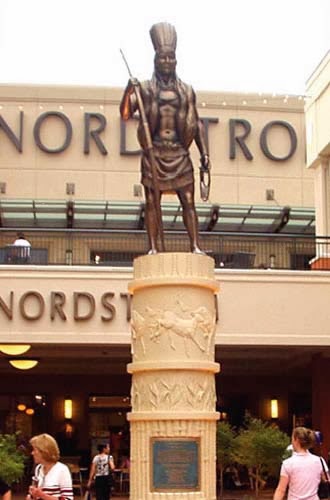
Evander (above) and Powhatan (romanticized by John Gadsby Chapman, below)

In the case of Powhatan, his ambiguous legacy lives on in the many place names that honor him as the aboriginal king who aided but was displaced by newly arrived colonists. The Mayo family, descendants of the city’s original surveyor, had lived for generations at a house called by them Powhatan’s Seat, on the hill east of Richmond that probably was the location of the local village of the Powhatan’s own tribe. The family carefully preserved at their house a talisman in the form of a stone said to have formed part of Powhatan’s house, sited in the native village at the falls which had been purchased by Captain John Smith and named by him “Nonesuch.” According to one source, the stone, covered with "Indian designs", also marked the grave of William Mayo. This stone, formerly located along the river, was moved to the crest of Chimborazo Hill, overlooking the river, when it was displaced by the city’s gasworks about 1911 [Christian 531]. 


The Powhatan Stone (Church Hill People’s News)
The antebellum Powhatan House Hotel on Broad Street where the Patrick 
Henry Building (the former State Library) stands today (above) 
and a bronze statue of Powhatan placed at Short Pump Town Square, 
a Henrico County shopping center (below).