“First, What kind of life was lived in this place, that is, Why and how did its builders build as they did?
And second, what rules with general validity and applicability did they follow?”
Carroll William Westfall, Learning From Pompeii.


Showing posts with label Powhatan. Show all posts

Tuesday, March 24, 2015

City of Monuments, Part I

Photographer Harry Stilson, Soldiers and Sailors Monument beyond 
[Style Magazine: from Richmond in Sight].
Movement through the city of Richmond is punctuated and articulated by an interconnecting series of urban-scale elements that serve to explicate, in concrete form, the city's formal connection with the past and its causal relationship to the future. In continuity with ancient and modern European and Near Eastern civic traditions, those in charge of the city’s individual and collective narratives have given voice to the city’s ideals and normative values by adding to a growing stock of monuments. These sculptural or architectural elements often served as carriers of didactic or hortatory meaning but always function as markers that clarify the city’s physical and political form and structure. 

The city’s monuments never stand alone: they join in loosely connected chains of meaning that extend across the city and through time to other cites around the world. We have explored the ways in which civic rituals like parades and processions make use of these armatures in this post.


As Lucien Steil has observed, many memorials record, not only celebrations, but times of disaster or suffering. Commemoration of great struggle and suffering  "is not about remembering and reviving acute and relentless destruction, terror, fear, etc., but about overcoming these moments of unbearable pain by moral and material acts of reconstruction. . . .  This creative sublimation of the experience of death and destruction, of horror and fear, into symbols of life, continuity and permanence is the paradoxical purpose of commemoration. . . . It is a necessary condition of any cultural endeavor of humanity" [Lucien F. Steil, "Reconstruction and Commemoration." American Arts Quarterly 4:3 (Winter 2015)]. 


The City’s Memorials

The urban-scale amenities that assist in ordering the city, making legible its structure and origins, both literally and figuratively, have been given various names through time. Here we are referring to amenities at the urban scale which have as their principal role the orientation of the citizen in both time and space. Traditionally, a city without such appropriate civic markers could make no claim to be a place of civility or a center of virtuous political life.

For the purposes of this discussion, these civic markers have been divided into three types: I. Memorials, II. Monuments, and III. Fountains. While each of these may combine some aspects of the others, mingling, for instance, sculpture and flowing water or bas relief and memorial inscription, most of the civic markers in the city can be chiefly identified under one or the other of these categories.      

Justin Shubow of the National Civic Art Society has defined two of these civic elements:
In current parlance, “monument” denotes a large (approximately at least 1.5 times the height of an average man) useless permanent immovable structure that honors its subject and was designed to be seen as such.  A monument is useless in the sense that it is not meant to have a function other than honoring and commemorating its subject. . . . All monuments are memorials, but not all memorials are monuments.  Some memorials contain monuments.  Monuments are clear and unequivocal in their meaning; memorials can be abstract and ambivalent.  Monuments immortalize their subjects; the subjects of memorials can be permanently dead or finished.  Monuments speak; memorials can stay silent.  Monuments need no signage; memorials often do.
An additional purpose for monuments is emphasized here: that of orienting the viewer within the city, both in the past and present.

I. Memorials

According to one commentator, a memorial is an “umbrella term for anything that serves in remembrance of a person or event,” while a monument is more specific: “a sculpture, structure, or physical marker designed to memorialize [Paul Williams, Memorial Museums: The Global Rush to Commemorate Atrocities. Gordonsville, VA: Berg, 2007 quoted in Collette Rachel Kinane, Addressing the Nation: The Use of Design Competitions in Interpreting Historic Sites. Master’s Thesis, U of Penn, 2012].” At the same time, a “memorial often signifies mourning and loss, whereas a monument signifies greatness or valor.” 

The earliest memorials in Richmond were the grave markers in the cemetery surrounding St. John’s Church at the top of Richmond Hill near the northeastern entry to the city at the top of 23rd Street as well as in the city’s successive African American burial grounds (the first Burying Ground for Negroes and the other public and private African American burying grounds that replaced it after 1816) on the sloping sides of Shockoe and Academy hills. It appears that many of the earlier burials at the city's cemeteries were not marked with stones. Stone grave markers would have been the exception in favor of wooden head and footboards. Those early stone markers which do survive at St. John’s not only incorporate carved decoration, but include inscriptions praising the virtues of the dead. 
St John's Churchyard in the early 20th century
The city was necessarily provided with places for burial of the dead. It appears that the races were separated from an early date, although there is no information concerning the places in which slaves and free blacks were buried in the 18th century. Henrico Parish had originally provided, as was regular practice in the established Church of England, a one-acre burial ground for the citizens of the town, all of whom were assumed to be members of the parish. 

Disestablishment of the church coincided with a need for an enlarged burial ground for whites. A first step was the purchase by the city, in 1799, of two adjacent lots on Broad Street to double the size of the burying ground to two acres. The city and church worked out a cooperative agreement for management of the graveyard that holds to this day.  


Shockoe Cemetery in 1865 showing overgrown lots and fenced graves with the 
City Almshouse beyond [Library of Congress]
Cenotaph tomb of William H. Cabell in Shockoe Cemetery
Early burials are not organized in any regular plan. The city’s numerous later cemeteries are laid out like miniature cities, with a grid pattern like Shockoe (1822) and Evergreen cemeteries (1891) or a picturesque layout like Hollywood (1847). In these graveyards, many of the earliest burials take the classical form of a cenotaph, or empty tomb, covered with a raised tombstone either raised on balusters like a table, or with the sides infilled to resemble a classical sarcophagus. Other gravestones used the traditional vertical form, sometimes provided with delicate carving representing themes associated with death and resurrection.


Turkey Island Obelisk, Henrico Historical Society

The unusual obelisk built in 1772 below Richmond on the plantation known as Turkey Island is often cited as an early monument memorializing the “Great Fresh,” a catastrophic flood. It has, however, recently been proposed that the obelisk was not intended for this purpose, but was primarily a component in an important early English Baroque rural landscape design [William Rhodes, "Ryland Randolph and the Palladian Triangle of Colonial Central Virginia." Presentation at the VCU Architectural History Symposium, 2012].

Monumental Church, Richmond
Richmond’s first purposeful civic monument was a constituent but self-contained part of a larger, hybrid work of architecture. Monumental Episcopal Church was planned in 1812 and completed in 1814 to memorialize a deadly theater fire on the same site. Designer Robert Mills grafted a dramatic thirty-two-foot-square monumental Aquia stone porch onto the front of an equally unusual octagonal stuccoed brick church. Mill’s portico is the architectural setting for a monument in the form of a Neoclassical funereal urn symbolically representing the shocking loss felt by Richmond’s citizens. The portico can also be seen as a monument: a symbolically detachable loggia or templum with details and materials contrasting with the body of the church. 

The relative independence of the loggia helps to justify the public funding of a sectarian church to memorialize members of the wider population. The exigencies of the situation suggested the hybrid nature of the monument; the city’s Episcopalians desired a new church and were prepared to build in the general area of the theater. The city improvised, not a new building type, but a largely unprecedented composite of models that would permit an effective memorial to those whose remains were indiscriminately mingled in the theater’s foundation. In combining the memorial to so large and diverse a group of victims in one monumental building, the city emphasized, not only a collective sense of loss, but a communal resolution to promote the public good. 
Monumental Church, Monument (John Milner Associates)
Like the raised table tombs that appeared in St. John’s Churchyard in the early nineteenth century, the neoclassical cenotaph at Monumental Church formed a symbolic repository for the bones of the dead, which were actually mingled in the earth beneath the church. Their bones were set aside and marked so that examples would live on in the lives of the city as a whole, whenever a passerby saw the marker or read the text. The monument which consisted of a sarcophagus form topped by an urn, similar to those used in Mycenean times to contain the bones of the dead, is a linear descendent of the tumulus which covered the tomb central to the cults of the Ancient Greek heroes. A form of immortality was achieved when the place of burial was made of permanent materials and the memory of the great deeds of the tomb's occupant was kept alive.   
Newport Cross, Richmond Canal Walk
The city’s expanding practice of monument-making also paid deference to the ancient importance of a founding myth, which we have explored here. In much the same way that Richmond was said, improbably, to have seven hills like Rome, in order to lend it a classical air, those responsible knew that by venerating its ancient founders the young city might acquire a sense of permanence. The first monument of the city’s founding may be the copper cross atop a rough pyramid of stones placed on Gamble’s Hill to mark the first visit to the falls by the English settlers. It was dedicated by the Association for the Preservation of Virginia Antiquities in 1907 (and relocated to the Canal Walk in 1983). The monument reenacted the planting of a cross by Captain Christopher Newport three hundred years before, which served to claim the land for the English monarch. The new version was intended to gave legitimacy to the ongoing project of making a city. 


Powhatan Stone, Chimborazo Park
The Mayo family, descendants of the city’s original surveyor, had lived for generations at Powhatan’s Seat, on the hill east of Richmond that probably served as the local seat of the Powhatan’s personal tribe. The Mayos carefully preserved at their house a talisman in the form of a stone said to have formed part of Powhatan’s house, sited in the native village at the falls which had been purchased by Captain John Smith and named by him “Nonesuch.” This stone, formerly located along the river, was moved to the crest of Chimborazo Park overlooking the river when it was displaced by the city’s gasworks about 1911. Oddly, William Byrd, the putative father of Richmond, who was an accomplished founder and namer of cities, which he once called “castles in the air,” was never honored with a monument at all, although his name has been applied to a park, a hotel, a theater, and a community center. 
Monument to the scuffle between British pickets and Virginia forces in 1781, Grove Avenue

One of the city’s earliest outdoor monuments was a small marble obelisk set up in 1834 to memorialize a skirmish between the otherwise victorious British Queen’s Rangers and the Virginia militia. According to the marker on Grove Avenue in the Fan District, probably placed by veterans of the engagement, Virginia forces under Col. J. Nicholas had “driven in” Arnold’s picket on 4 January, 1781. Benedict Arnold had taken Richmond in late 1780 and a regiment under Lt. Col John Simcoe were returning from burning the foundry at Westham west of Richmond. This may have been the “scuffle” for which the nearby hamlet of Scuffletown was named [Drew St.J. Carneal. Richmond’s Fan District. Historic Richmond Foundation, 1996, 14-15].      

The two hundredth anniversary of the incorporation of Richmond as a city and of its elevation from a county seat to the state capital was memorialized in 1982. A plaque was appropriately placed at the Old Henrico Courthouse on East Main Street to mark the site where, in the absence of any other city meeting place, there took place the initial election of the twelve members of the city's common hall and of its first mayor, William Foushee.

Memorial plaque at the Old Henrico County Courthouse recognizing the election there of the
city's first governing body.


Hebrew Confederate Cemetery, Richmond, Virginia [Hebrew Cemetery]
Although there were non-sculptural memorials set up before the Civil War, the Confederacy became the subject of the city’s greatest outpouring of memorial-making. The elaborate iron fence surrounding the Hebrew Confederate Cemetery was made in 1866. The posts consist of furled Confederate flags and stacked muskets, with a soldier's cap perched on top. The posts are connected by sabers and swords hung with laurel wreaths. The earliest large-scale monument, built in 1869, rose in Hollywood Cemetery to honor the thousands of dead soldiers buried around it. The ninety-foot granite pyramid reinforced a ritualized theme of loss and death. A large marble obelisk at Oakwood Cemetery in the city’s east end followed soon after funds were raised by 1871.

Confederate Monument, Oakwood Cemetery
Confederate Monument, Hollywood Cemetery


The memorialization of history became institutionalized soon after. Plaques recording locations and events were attached to buildings by the Confederate Memorial Literary Society in the first decades of the twentieth century, including the site of Libby Prison in 1911. The series of “Freeman Markers” named for author and editor Douglas Southall Freeman, who promoted them and wrote the texts around 1925, mark the locations of fortifications and battlefields in and around the city for the use of tourists and returning veterans. 
Freeman Marker
A consideration of monuments follows in Richmond's Civic Markers, Part II, located here.


Confederate Memorial Plaque at the Old Henrico
Courthouse on East Main Street


Friday, October 11, 2013

Founding Mythologies


How very differently do we shape our history in
 Virginia, where we accept such facts as we find
 desirable and dismiss those which are not to our
 purpose! . . . The great epic of Virginia’s settlement
 may not have occurred precisely as Virginians narrate
 it; yet that suspicion may be raised likewise as to the
 Odyssey and the Aeneid without prompting us to
 contemn any one of these three masterworks.
James Branch Cabell, Let Me Lie, 1947

The Gov. Botetourt statue when it stood at William and Mary College [Louise Manly, Southern Literature, 1900]
Richmond’s self-understanding has long paid lip-service to the ancient importance of a founding myth. Richmond was said, implausibly, by its nineteenth-century promoters, to have seven hills, like Rome, in order to lend it a classical air. Civic leaders across the nation had always employed rhetorical narratives that venerated their ancient founders. Virginia, indeed, began a tradition of public statuary with the statue of a much loved royal governor. One of the earliest examples of public statuary in the colonies, the statue of Lord Botetourt was placed in the central arcade of the Williamsburg Capitol in 1773. 

At first, Richmond, in its role as capitol of the commonwealth, built its narrative around political (and military) figures. The state’s leaders memorialized the founding fathers and the larger-than life role Virginians played in the founding of the nation. In 1796, Houdon’s virtuoso life-size sculpture of George Washington took a central place in the new Capitol, the same position that was occupied by Lord Botetourt’s statue in Williamsburg. Both Botetourt and Washington were here dressed in modern garb, although Washington was accompanied by the symbols of the Roman hero Cincinnatus, who, like Washington, turned from war-craft to farming. 

The Washington Monument of 1858 [Joel Cook, 1900]
The Houdon Washington was followed in Capitol Square in 1858 by a great monument to the Revolutionary generation by sculptor Thomas Crawford, hoped by its planners to be the burial place for Washington himself.  It was topped with an equestrian statue of Washington placed on axis with Grace Street. The huge allegorical composition was completed with encircling statues of Patrick Henry, Thomas Jefferson, Andrew Lewis, John Marshall, George Mason, and Thomas Nelson in 1869. Other statues followed in Capitol Square, including Henry Clay (sculptor Joel Hart, 1860). After 1865, the city’s former role as Confederate Capital meant that it carried the weight of much of the post-war symbol-making that overlaid the essentially tragic viewpoint of the Lost Cause. The Confederate heroes were treated much the same as the Revolutionary generation in former years. None of the Confederates, not even Lee, could participate in the city’s founding narratives.   

As the nation’s wealth increased, the number of monuments and dedicatory inscriptions multiplied, with the hope that the increasing numbers of immigrants would absorb the values of the republic. Some have seen in the veneration of heroes the establishment of a “civil religion,” a nonsectarian national faith which serves to promote cultural and social integration. At the same time, the conflation of faith with national symbols and heroes may result more from the historic permeation of American civil life with both classical and religious imagery and the strong connections, perceived by Tocqueville, between individual liberty and historic American forms of Protestantism. At the beginning of the twentieth century, the American Renaissance, a broad-based design movement looking back to Europe as a source for urban and architectural patterns, gave physical form to the search for narrative meaning expressed in the nation’s many new statues and monumental settings. Richmond’s leaders looked to the region’s earliest history for municipal heroes eligible for veneration.

Roman legend acknowledges the heroes Aeneas, Romulus, and Evander as alternate founders. In much the same way, (but probably not with any intentional parallel) there are at least three putative founders for Richmond, each of whom is remembered and celebrated through the naming of civic buildings or parks and by means of monuments or memorial tablets. These founders are, first, the English settlers (sometimes personified by Captain John Smith), who, like Aeneas and his men, came from the old country, claimed the land, and conquered the natives. The city recognizes a second founder, William Byrd II, who, like Romulus, later subdivided the land to form a town. Thirdly, the city remembers Powhatan, who, like Evander at Rome, was a powerful “king” of the natives whose principal village was believed to have previously been located at the falls of the James. Each of these “founders” demonstrated classical virtues that gave mythical weight to the project of building the New South city of Richmond. 

Aeneas from the Ara Pacis (above) and Capt. John Smith (below)


Virginia honored the hardships associated with first English settlements as the heroic sacrifice of a determined band of colonists (instead of, as James Branch Cabell observed, “a rather commonplace set [of] thieving opportunists”). The first monument of the city’s “founding” may be the copper cross atop a rough pyramid of stones placed on Gamble’s Hill to mark the first visit to the falls by English explorers headed by Christopher Newport. Newport’s band, which included the far better known John Smith, ventured up what they called the Powhatan River only a month after their first arrival in Virginia. 

The “Newport Cross” today [wikipedia]
The monument was dedicated by the Association for the Preservation of Virginia Antiquities in 1907 (and relocated to the Canal Walk in 2003). The act of re-planting the cross that was erected three hundred years before to claim the land for the English monarch gave legitimacy to the ongoing project of making a city.  Captain John Smith, who purchased the native village at the falls from Powhatan and renamed it “Nonesuch,” has been attributed with heroic, even mythological status for many years in connection with the founding of the state and nation. 

Romulus, Victorious (detail) by Ingres (above) 
and Col. William Byrd (below) 
by Paul Cadmus (after Hans Hysing) 1939, one of a 
mural series in the Lewis Powell Federal Courthouse Annex, 
Richmond, Virginia [Carol M. Highsmith Archive LOC].


Oddly, William Byrd, the putative father of Richmond, who was an accomplished founder and namer of cities, was never honored with a monument or statue at all, perhaps because of his ironic, rakish attitude, although his name has been applied to a park, a hotel, a movie theater, and a community center. William Byrd, a compelling writer, explorer, and scholarly jokester, would have very much enjoyed the unconsciously mock heroic tone of the tablet placed at Westover in his honor (and that of the early settlers at the falls) at the Bicentenary celebrations of the city’s founding in 1937:

From this spacious dwelling Colonel WILLIAM BYRD
 the Second of WESTOVER set out in 1737 to lay
 the foundations and to project the future of the CITY
 OF RICHMOND. Its grateful citizens, recalling the
 sufferings bourne and the glories experienced, the
 duties met and the common purposes achieved, the
 physical conquests realized and the spiritual powers
 evoked, by this tablet record their debt to the large 
concept of the FOUNDER and their obligation for the
 unfailing courage, the ever-springing foresight, and
 the controlling patriotism of their forbears. 


The Byrd Theatre (above) and the William Byrd Hotel (below)


Evander (above) and Powhatan (romanticized by John Gadsby Chapman, below)

In the case of Powhatan, his ambiguous legacy lives on in the many place names that honor him as the aboriginal king who aided but was displaced by newly arrived colonists. The Mayo family, descendants of the city’s original surveyor, had lived for generations at a house called by them Powhatan’s Seat, on the hill east of Richmond that probably was the location of the local village of the Powhatan’s own tribe. The family carefully preserved at their house a talisman in the form of a stone said to have formed part of Powhatan’s house, sited in the native village at the falls which had been purchased by Captain John Smith and named by him “Nonesuch.” According to one source, the stone, covered with "Indian designs", also marked the grave of William Mayo. This stone, formerly located along the river, was moved to the crest of Chimborazo Hill, overlooking the river, when it was displaced by the city’s gasworks about 1911 [Christian 531]. 


The Powhatan Stone (Church Hill People’s News)
The antebellum Powhatan House Hotel on Broad Street where the Patrick 
Henry Building (the former State Library) stands today (above) 
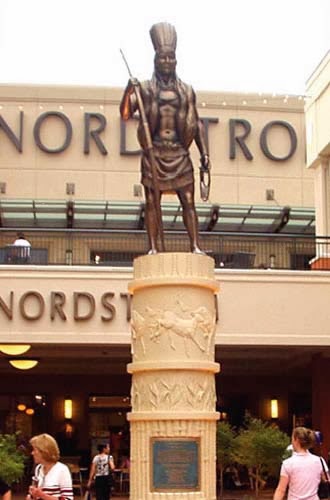
and a bronze statue of Powhatan placed at Short Pump Town Square, 
a Henrico County shopping center (below).