“First, What kind of life was lived in this place, that is, Why and how did its builders build as they did?
And second, what rules with general validity and applicability did they follow?”
Carroll William Westfall, Learning From Pompeii.


Showing posts with label Washington. Show all posts

Wednesday, April 9, 2014

GOOD AND BAD GOVERNMENT

"Peace" from the Allegory 
of Good Government
Urbanismo spends a lot of time making parallels between traditional American urbanism and old-world cities in Italy and England. Martha Banta, in her book One True Theory and the Quest for an American Aesthetic (Yale U Press, 2007, 104-5) makes a significant point about the most important uses of public art, one that we would do well to consider:
"Washington DC was unable to provide what the Italian tradition had so much of- well-trained artists and artisans possessed of many skills, the cooperation of guildsmen and bureaucrats, and the willingness of the communes to pay the necessary costs in money and patronage- yet there are certain similarities between what Florence and Rome achieved through their art and architecture and the motives that lay behind America’s capital. Some of these connections are strong, others are loose, but together they provide comparative perspectives that aid in a better understanding of what is involved in making a public art that matched public policies. Both decided that what mattered most was the celebration of the virtus of government power, not the virtu of good government. . . . 
But what is present in Siena’s Palazzo Pubblico and sorely missed in the Capitol are frescoes that are visual indicators of what is required of a country’s civic leaders if they wish to advance beyond mere economic and military victories. The three walls in the Sala della Pace (or Sala d’Nove) are covered by Ambrogio Lorenzetti’s murals of 1338-39, allegories known as the Good Government and Bad Government. Beyond their great beauty and the proud position they hold in art history for initiating major innovations in theme and technique is their quiet affirmation of the importance of the city’s commitment to a system based on serving the people with honesty and justice.”  

Detail of Bad Government -The figure of justice lies bound at the feet of tyranny


                                                 Detail of Good Government - The inscription reads:  
“Turn your eyes to behold her, you who are governing, who is portrayed here [Justice], crowned on account of her excellence, who always renders to everyone his due. Look how many goods derive from her and how sweet and peaceful is that life of the city where is preserved this virtue who outshines any other. She guards and defends those who honor her, and nourishes and feeds them. From her light is both requiting those who do good and giving due punishment to the wicked."
The Allegory and Effects of Good and Bad Government in Sienna's Palazzo Publico (Town Hall) was commissioned in the 1330s to remind the assembled councillors of the importance of virtue in government, by contrasting just republican government with corrupt tyrannical rule.  
Friday, October 11, 2013

Founding Mythologies


How very differently do we shape our history in
 Virginia, where we accept such facts as we find
 desirable and dismiss those which are not to our
 purpose! . . . The great epic of Virginia’s settlement
 may not have occurred precisely as Virginians narrate
 it; yet that suspicion may be raised likewise as to the
 Odyssey and the Aeneid without prompting us to
 contemn any one of these three masterworks.
James Branch Cabell, Let Me Lie, 1947

The Gov. Botetourt statue when it stood at William and Mary College [Louise Manly, Southern Literature, 1900]
Richmond’s self-understanding has long paid lip-service to the ancient importance of a founding myth. Richmond was said, implausibly, by its nineteenth-century promoters, to have seven hills, like Rome, in order to lend it a classical air. Civic leaders across the nation had always employed rhetorical narratives that venerated their ancient founders. Virginia, indeed, began a tradition of public statuary with the statue of a much loved royal governor. One of the earliest examples of public statuary in the colonies, the statue of Lord Botetourt was placed in the central arcade of the Williamsburg Capitol in 1773. 

At first, Richmond, in its role as capitol of the commonwealth, built its narrative around political (and military) figures. The state’s leaders memorialized the founding fathers and the larger-than life role Virginians played in the founding of the nation. In 1796, Houdon’s virtuoso life-size sculpture of George Washington took a central place in the new Capitol, the same position that was occupied by Lord Botetourt’s statue in Williamsburg. Both Botetourt and Washington were here dressed in modern garb, although Washington was accompanied by the symbols of the Roman hero Cincinnatus, who, like Washington, turned from war-craft to farming. 

The Washington Monument of 1858 [Joel Cook, 1900]
The Houdon Washington was followed in Capitol Square in 1858 by a great monument to the Revolutionary generation by sculptor Thomas Crawford, hoped by its planners to be the burial place for Washington himself.  It was topped with an equestrian statue of Washington placed on axis with Grace Street. The huge allegorical composition was completed with encircling statues of Patrick Henry, Thomas Jefferson, Andrew Lewis, John Marshall, George Mason, and Thomas Nelson in 1869. Other statues followed in Capitol Square, including Henry Clay (sculptor Joel Hart, 1860). After 1865, the city’s former role as Confederate Capital meant that it carried the weight of much of the post-war symbol-making that overlaid the essentially tragic viewpoint of the Lost Cause. The Confederate heroes were treated much the same as the Revolutionary generation in former years. None of the Confederates, not even Lee, could participate in the city’s founding narratives.   

As the nation’s wealth increased, the number of monuments and dedicatory inscriptions multiplied, with the hope that the increasing numbers of immigrants would absorb the values of the republic. Some have seen in the veneration of heroes the establishment of a “civil religion,” a nonsectarian national faith which serves to promote cultural and social integration. At the same time, the conflation of faith with national symbols and heroes may result more from the historic permeation of American civil life with both classical and religious imagery and the strong connections, perceived by Tocqueville, between individual liberty and historic American forms of Protestantism. At the beginning of the twentieth century, the American Renaissance, a broad-based design movement looking back to Europe as a source for urban and architectural patterns, gave physical form to the search for narrative meaning expressed in the nation’s many new statues and monumental settings. Richmond’s leaders looked to the region’s earliest history for municipal heroes eligible for veneration.

Roman legend acknowledges the heroes Aeneas, Romulus, and Evander as alternate founders. In much the same way, (but probably not with any intentional parallel) there are at least three putative founders for Richmond, each of whom is remembered and celebrated through the naming of civic buildings or parks and by means of monuments or memorial tablets. These founders are, first, the English settlers (sometimes personified by Captain John Smith), who, like Aeneas and his men, came from the old country, claimed the land, and conquered the natives. The city recognizes a second founder, William Byrd II, who, like Romulus, later subdivided the land to form a town. Thirdly, the city remembers Powhatan, who, like Evander at Rome, was a powerful “king” of the natives whose principal village was believed to have previously been located at the falls of the James. Each of these “founders” demonstrated classical virtues that gave mythical weight to the project of building the New South city of Richmond. 

Aeneas from the Ara Pacis (above) and Capt. John Smith (below)


Virginia honored the hardships associated with first English settlements as the heroic sacrifice of a determined band of colonists (instead of, as James Branch Cabell observed, “a rather commonplace set [of] thieving opportunists”). The first monument of the city’s “founding” may be the copper cross atop a rough pyramid of stones placed on Gamble’s Hill to mark the first visit to the falls by English explorers headed by Christopher Newport. Newport’s band, which included the far better known John Smith, ventured up what they called the Powhatan River only a month after their first arrival in Virginia. 

The “Newport Cross” today [wikipedia]
The monument was dedicated by the Association for the Preservation of Virginia Antiquities in 1907 (and relocated to the Canal Walk in 2003). The act of re-planting the cross that was erected three hundred years before to claim the land for the English monarch gave legitimacy to the ongoing project of making a city.  Captain John Smith, who purchased the native village at the falls from Powhatan and renamed it “Nonesuch,” has been attributed with heroic, even mythological status for many years in connection with the founding of the state and nation. 

Romulus, Victorious (detail) by Ingres (above) 
and Col. William Byrd (below) 
by Paul Cadmus (after Hans Hysing) 1939, one of a 
mural series in the Lewis Powell Federal Courthouse Annex, 
Richmond, Virginia [Carol M. Highsmith Archive LOC].


Oddly, William Byrd, the putative father of Richmond, who was an accomplished founder and namer of cities, was never honored with a monument or statue at all, perhaps because of his ironic, rakish attitude, although his name has been applied to a park, a hotel, a movie theater, and a community center. William Byrd, a compelling writer, explorer, and scholarly jokester, would have very much enjoyed the unconsciously mock heroic tone of the tablet placed at Westover in his honor (and that of the early settlers at the falls) at the Bicentenary celebrations of the city’s founding in 1937:

From this spacious dwelling Colonel WILLIAM BYRD
 the Second of WESTOVER set out in 1737 to lay
 the foundations and to project the future of the CITY
 OF RICHMOND. Its grateful citizens, recalling the
 sufferings bourne and the glories experienced, the
 duties met and the common purposes achieved, the
 physical conquests realized and the spiritual powers
 evoked, by this tablet record their debt to the large 
concept of the FOUNDER and their obligation for the
 unfailing courage, the ever-springing foresight, and
 the controlling patriotism of their forbears. 


The Byrd Theatre (above) and the William Byrd Hotel (below)


Evander (above) and Powhatan (romanticized by John Gadsby Chapman, below)

In the case of Powhatan, his ambiguous legacy lives on in the many place names that honor him as the aboriginal king who aided but was displaced by newly arrived colonists. The Mayo family, descendants of the city’s original surveyor, had lived for generations at a house called by them Powhatan’s Seat, on the hill east of Richmond that probably was the location of the local village of the Powhatan’s own tribe. The family carefully preserved at their house a talisman in the form of a stone said to have formed part of Powhatan’s house, sited in the native village at the falls which had been purchased by Captain John Smith and named by him “Nonesuch.” According to one source, the stone, covered with "Indian designs", also marked the grave of William Mayo. This stone, formerly located along the river, was moved to the crest of Chimborazo Hill, overlooking the river, when it was displaced by the city’s gasworks about 1911 [Christian 531]. 


The Powhatan Stone (Church Hill People’s News)
The antebellum Powhatan House Hotel on Broad Street where the Patrick 
Henry Building (the former State Library) stands today (above) 
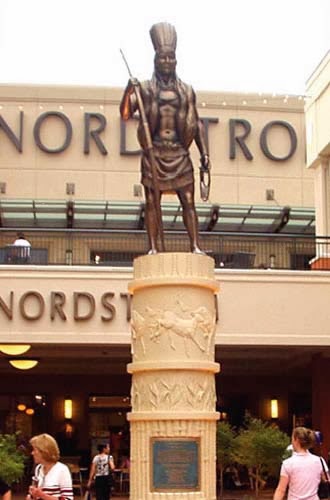
and a bronze statue of Powhatan placed at Short Pump Town Square, 
a Henrico County shopping center (below).